Barbell Deadlift
 Anton YefanovUpdated
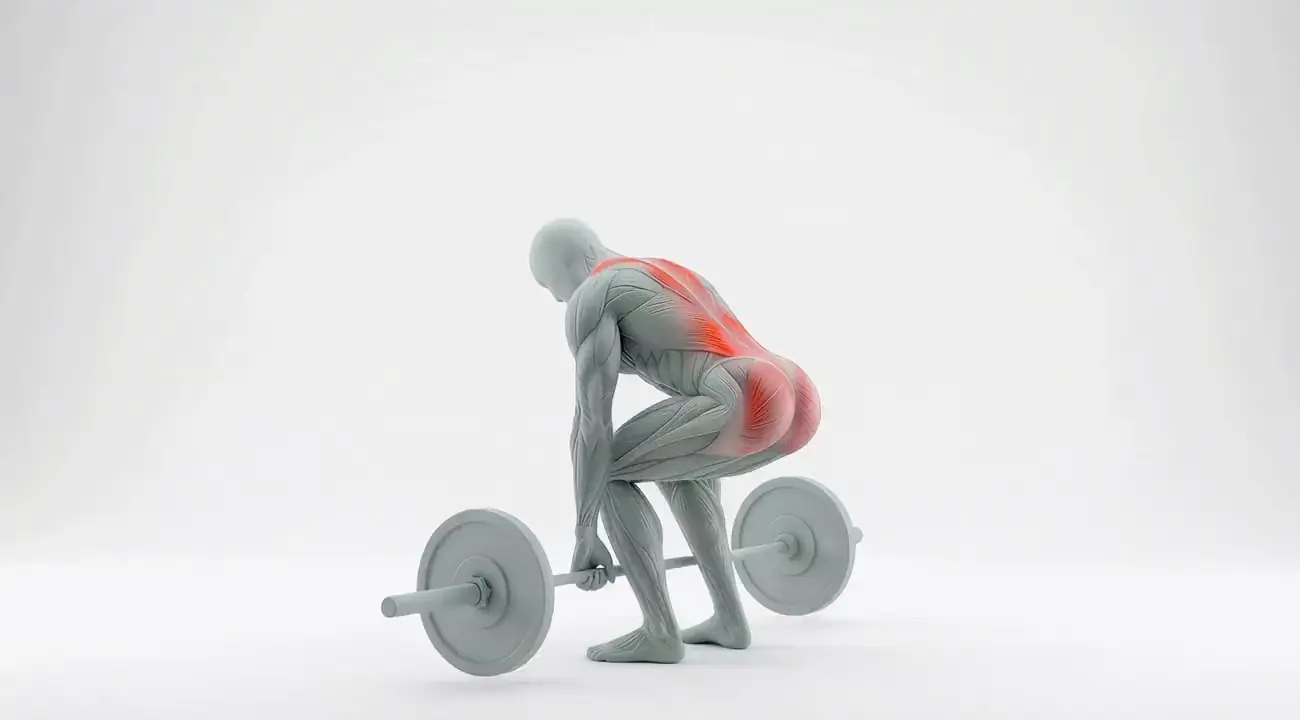
The barbell deadlift is the heaviest lift most people will ever perform. The lifter pulls the bar from the floor to a standing lockout in a single hinge pattern, training the lower back, mid-back, glutes, and hamstrings together under maximum load. It's the lift powerlifters compete in, athletes use to build pulling strength, and lifelong gymgoers return to as the truest test of full-body strength.
How to do the Barbell Deadlift
- Stand with feet hip-width apart, the bar over mid-foot, and shins about an inch from the bar.
- Hinge down and grip the bar just outside the knees with a flat back and chest tall.
- Pull the slack out of the bar, brace your core, and take a big breath into your stomach.
- Push the floor away with your legs while keeping the bar dragging close to your shins.
- Stand fully tall by squeezing the glutes and locking out the hips and knees together.
- Lower the bar by hinging at the hips first, then bending the knees once it passes them.
Muscles worked
- Secondary:
- Glutes


Why train it
- Builds total-body pulling strength led by the back, glutes, and hamstrings.
- Trains the hinge pattern that protects the back in everyday lifting.
- Develops grip, core bracing, and full-body tension under heavy load.
Common mistakes
- Rounding the lower back on the lift-off, which puts the spine in a weak position under heavy load.
- Yanking the bar off the floor without pulling the slack first, leading to a jerky pull and missed reps.
- Letting the bar drift away from the shins, which lengthens the lever arm and crushes the lower back.
- Hyperextending at the top instead of finishing with a tight glute squeeze and stacked rib cage.
Frequently asked questions
Is the deadlift a back or leg exercise?
Both. Your legs and glutes drive the bar off the floor and lock it out. Your upper and lower back hold your spine still under the load, and your traps and grip hold the bar. That is why it shows up on back days and leg days, and why one heavy session a week is enough for most people.
Should you feel deadlifts in your lower back?
You should feel your lower back working hard to hold its position, as a dull effort that fades between sets. You should not feel a sharp pain or a pump that lingers in the lower back after the set. That usually means the back rounded or the bar drifted away from your shins. Lighten the weight and keep the bar in contact with your legs the whole way.
Should you deadlift every week?
Once a week is plenty for most lifters. A heavy deadlift is tiring for your whole body, and it can take longer to recover from than a squat or a bench at the same effort. Plenty of programs keep one heavy deadlift day and use a lighter hinge, like the Romanian Deadlift, on a second day.
Do deadlifts stunt your growth?
No. That fear goes back to old case reports of growth plate injuries in young people lifting without supervision. Current guidance from the American Academy of Pediatrics is that well-designed, supervised resistance training has no negative effect on growth in children or teenagers. The risk is lifting maximal weights without coaching, not the deadlift itself.
What is a good deadlift weight?
A rough guide for men is around 1.5 times bodyweight after a year or two of steady training, and twice bodyweight or more for strong recreational lifters. For women, around 1.25 times bodyweight is solid and 1.75 times is strong. Treat these as signposts, not targets: limb length changes the numbers a lot, and your own trend over time is the number that counts.
What equipment do I need for the Barbell Deadlift?
Only a barbell. Nothing beyond that is required to run the movement the way it is described above.
Is the Barbell Deadlift suitable for beginners?
With some training behind you. The Barbell Deadlift is rated intermediate, which means the setup matters as much as the effort. It is a reasonable first month goal rather than a first session one, and the alternatives below are the easier way in.
Can I do the Barbell Deadlift at home?
Yes, if you own a barbell. That is the whole requirement, and it is the reason this one travels well between a home setup and a gym floor.
How many sets and reps of the Barbell Deadlift should I do?
Three to five sets of 5 to 8 reps for strength, or 8 to 12 for size. A hinge is heavy on the lower back, so leave a rep in the tank and rest two to three minutes between sets.
What are good alternatives to the Barbell Deadlift?
Barbell Rack Pull, Bodyweight Deadlift, and Machine 45 Degree Back Extension train the same primary muscles as the Barbell Deadlift. Pick whichever one suits the equipment in front of you.
Work out your Barbell Deadlift weights
Estimate your max from a recent set, then find the weight for your next one.
- One Rep Max CalculatorTurn a recent set into an estimated max. Compare Epley, Brzycki and Lombardi, then read off your training percentages and every rep max from 2RM to 12RM.
- RPE CalculatorRate a set by effort, get an estimated max, and read off the weight for your next target. Includes a full RPE chart of percentages by reps and effort.
- Barbell Plate CalculatorSee which plates go on each side of the bar for any weight, using only what your gym stocks. Count a loaded bar, add collars, and switch bars.
- Warm-Up CalculatorGet every warm-up set for your working weight, with reps, rest and the plates per side. Ramps for work sets, heavy singles, meets and 5x5 programs.
Similar exercises


By muscle
Every exercise is mapped to the muscles it trains. Browse by what you want to build.
By equipment
A full gym, a pair of dumbbells, or nothing at all: browse by what you have.