Barbell Bench Press
 Anton YefanovUpdated
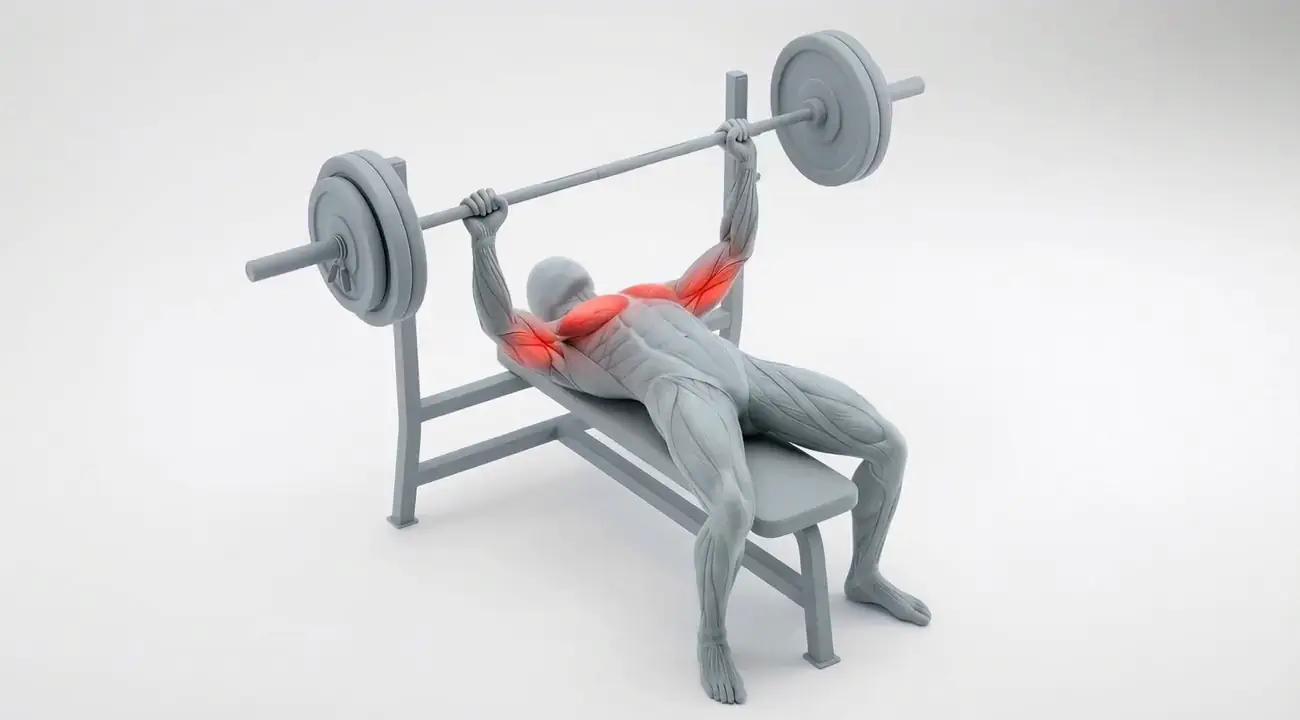
The barbell bench press is the most recognized strength exercise in the world. It builds the chest, triceps, and front shoulders through a controlled horizontal press, and it remains the gold standard for measuring upper-body pressing strength in both training programs and powerlifting competitions.
How to do the Barbell Bench Press
- Lie on the bench with your eyes directly under the bar and your feet planted flat on the floor.
- Pull your shoulder blades back and down into the bench to create a stable pressing platform.
- Grip the bar slightly wider than shoulder width with wrists stacked over elbows, then unrack to full arm extension.
- Lower the bar slowly to your lower chest with elbows tracked at about 60 to 75 degrees from your torso.
- Pause briefly with the bar touching the chest, keeping full-body tension and a tight upper back.
- Drive the bar back up explosively by pressing through the chest and triceps until the arms lock out.
Muscles worked


Why train it
- Builds raw horizontal pressing strength for sport and lifting.
- Develops chest mass, triceps thickness, and front-delt size.
- Reinforces full-body stability and bracing under heavy load.
Common mistakes
- Letting the elbows flare to 90 degrees, which strains the front shoulders and reduces chest engagement.
- Losing the shoulder-blade squeeze mid-rep, causing the shoulders to roll forward under load.
- Bouncing the bar off the chest to use momentum instead of a controlled touch or pause.
- Lifting the glutes off the bench for leverage, which destabilizes the lift and risks back strain.
Frequently asked questions
Should the bar touch your chest on the bench press?
Yes, lightly. Touching the lower chest on every rep gives you a consistent depth, and it is the standard in powerlifting. A touch is not a bounce: the bar should land soft and leave under control. If touching hurts your shoulders, shorten the range with a thin pad or a board for a while rather than stopping at a different height each rep.
Is the bench press bad for your shoulders?
Not when the setup is right. Most bench press shoulder pain comes from two things: elbows flared out to 90 degrees, and shoulder blades that drift forward off the bench as the set goes on. Keep the elbows at roughly 45 to 75 degrees from your sides, keep the upper back pinned, and the front of the shoulder takes far less stress. Pain that stays sharp after those fixes is worth getting looked at.
Should you arch your back on the bench press?
A moderate arch, yes. Lifting the chest and squeezing the shoulder blades together naturally puts a small arch in the upper and mid back, and that shortens the bar path and protects the shoulders. Your glutes and upper back should stay on the bench. An extreme arch is a competition technique for moving the most weight, and you do not need it to build muscle.
Does the bench press work the upper chest?
Some, but mostly the middle and lower chest. The flat bench press leans on the larger, lower part of the pecs. The Barbell Incline Bench Press at about 30 degrees moves more of the work to the upper chest and front shoulders, so many programs run both.
Is the barbell or dumbbell bench press better?
Neither wins outright. The barbell lets you lift more and add weight in small, steady steps, which suits strength work. The Dumbbell Bench Press gives a deeper stretch at the bottom and makes each arm do its own share. For building muscle, both work well, so use the one you will progress on, or rotate them.
What muscles does the Barbell Bench Press work?
The Barbell Bench Press trains the chest as the main target. Expect the triceps to take some of the load as well.
What equipment do I need for the Barbell Bench Press?
Only a barbell. Nothing beyond that is required to run the movement the way it is described above.
Is the Barbell Bench Press suitable for beginners?
With some training behind you. The Barbell Bench Press is rated intermediate, which means the setup matters as much as the effort. It is a reasonable first month goal rather than a first session one, and the alternatives below are the easier way in.
Can I do the Barbell Bench Press at home?
Yes, if you own a barbell. That is the whole requirement, and it is the reason this one travels well between a home setup and a gym floor.
How many sets and reps of the Barbell Bench Press should I do?
Three to five sets of 6 to 12 reps. Sit at the lower end with heavier weight when you are chasing strength, and at the upper end when you are chasing size.
What are good alternatives to the Barbell Bench Press?
Bodyweight Elevated Push Up, Cable Low-to-High Fly, and Decline Machine Chest Press train the same primary muscles as the Barbell Bench Press. Pick whichever one suits the equipment in front of you.
Work out your Barbell Bench Press weights
Estimate your max from a recent set, then find the weight for your next one.
- One Rep Max CalculatorTurn a recent set into an estimated max. Compare Epley, Brzycki and Lombardi, then read off your training percentages and every rep max from 2RM to 12RM.
- RPE CalculatorRate a set by effort, get an estimated max, and read off the weight for your next target. Includes a full RPE chart of percentages by reps and effort.
- Barbell Plate CalculatorSee which plates go on each side of the bar for any weight, using only what your gym stocks. Count a loaded bar, add collars, and switch bars.
- Warm-Up CalculatorGet every warm-up set for your working weight, with reps, rest and the plates per side. Ramps for work sets, heavy singles, meets and 5x5 programs.
Similar exercises
 Barbell Incline Bench PressBarbell
 Decline Barbell Bench PressBarbell
 Barbell High Incline Bench PressBarbell
 Wide-Grip Barbell Bench PressBarbell
 Reverse-Grip Barbell Bench PressBarbell
 Barbell Floor PressBarbell
 Cable Bench PressCable
 Dumbbell Bench PressDumbbell
 Kettlebell Bench PressKettlebell
 Cable Decline Bench PressCable
By muscle
Every exercise is mapped to the muscles it trains. Browse by what you want to build.
By equipment
A full gym, a pair of dumbbells, or nothing at all: browse by what you have.